Towing Company Charges 2025: Fair Guide
Why Understanding Towing Company Charges Matters
Towing company charges can be confusing and unexpected. Getting your vehicle towed is stressful enough; the last thing you need is a bill you don’t understand. Whether you’re a property manager handling parking enforcement or a resident whose car was towed, knowing what to expect is essential.
Typical towing charges include:
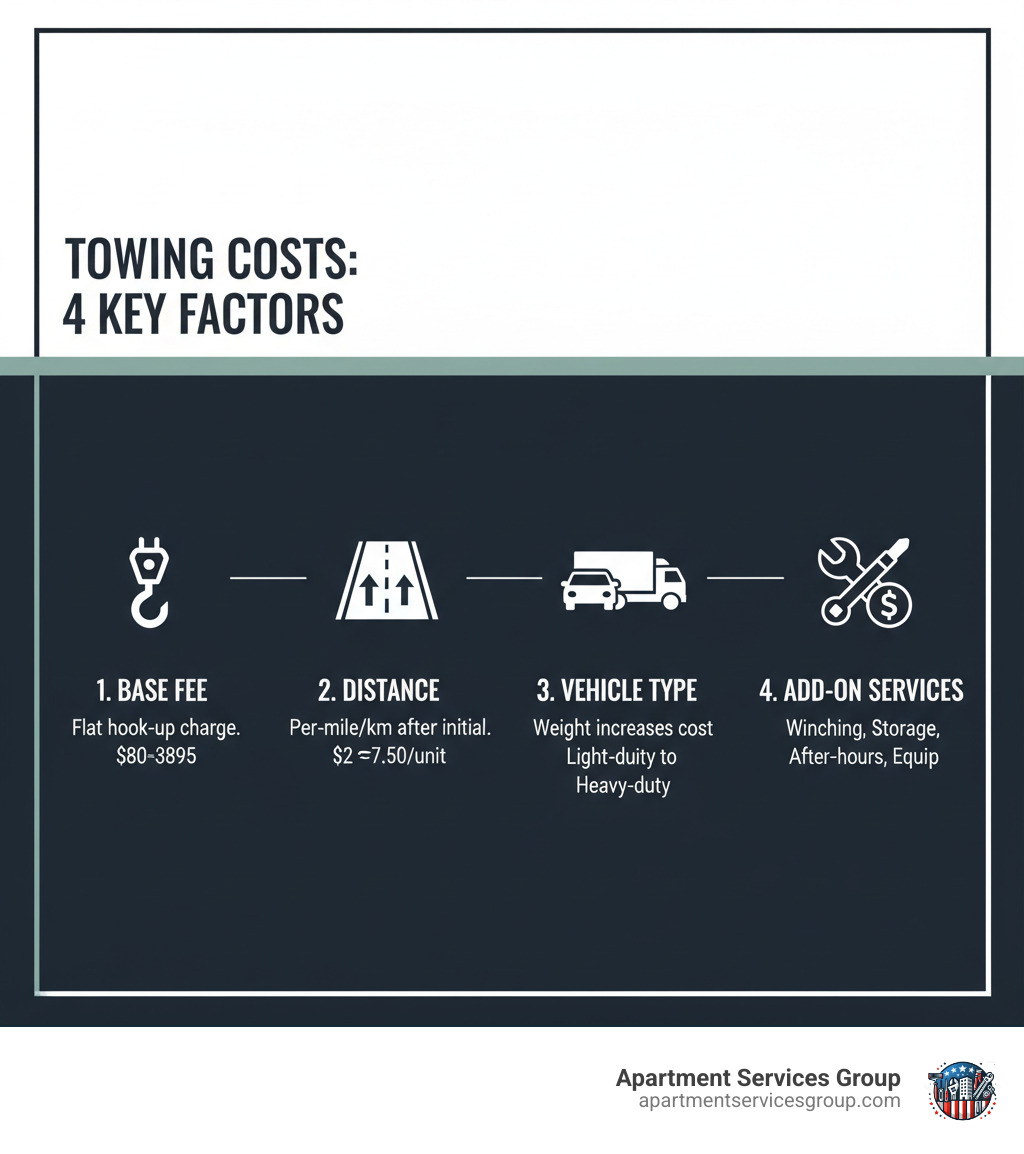
- Base Fee (Hook-up Charge): A flat rate that can range from $80 to over $800.
- Per-Mile/Kilometer Fee: An additional charge for distance, usually $2 to $7.50 per unit.
- Additional Services: Fees for winching, storage, or after-hours service.
- Vehicle Weight: Costs increase for heavier vehicles like trucks and RVs.
Rates vary dramatically by region due to local regulations, the type of tow, distance, and time of day. For example, a basic tow might start at $100 in one city but be legally capped at a different rate elsewhere. Understanding these factors helps you identify legitimate charges and avoid being overcharged.
As Moe Shariff, owner of American Towing Group and Apartment Services Group, I’ve seen the confusion these charges cause. With over eight years in Houston’s towing and property management industries, we’ve helped countless properties implement fair, transparent towing practices that protect everyone involved.
Breaking Down the Bill: Standard Towing Costs Explained
Understanding how towing company charges break down can give you a sense of control in a stressful situation. Every tow bill starts with a few key components.
First is the base fee or hook-up charge. This covers the truck’s arrival and the driver’s work, often including the first few miles of the tow. This fee varies widely by location. In some cities, it might be $80 to $150, while in other regulated areas, it could be significantly higher, sometimes including the first 10 kilometers.
Once you exceed the included mileage, you’ll see per-kilometer or per-mile fees. These typically range from $2 to $7.50 per unit of distance. For example, after an initial 10 kilometers, some companies charge $5.00 per kilometer for light-duty vehicles. These regional price variations are significant, so what seems expensive in one area might be standard in another. Always ask for a quote that separates the base fee from mileage charges.
How do distance and vehicle type affect towing company charges?
Not all vehicles cost the same to tow. The key factor is the Gross Vehicle Weight Rating (GVWR), which determines the type of equipment needed.
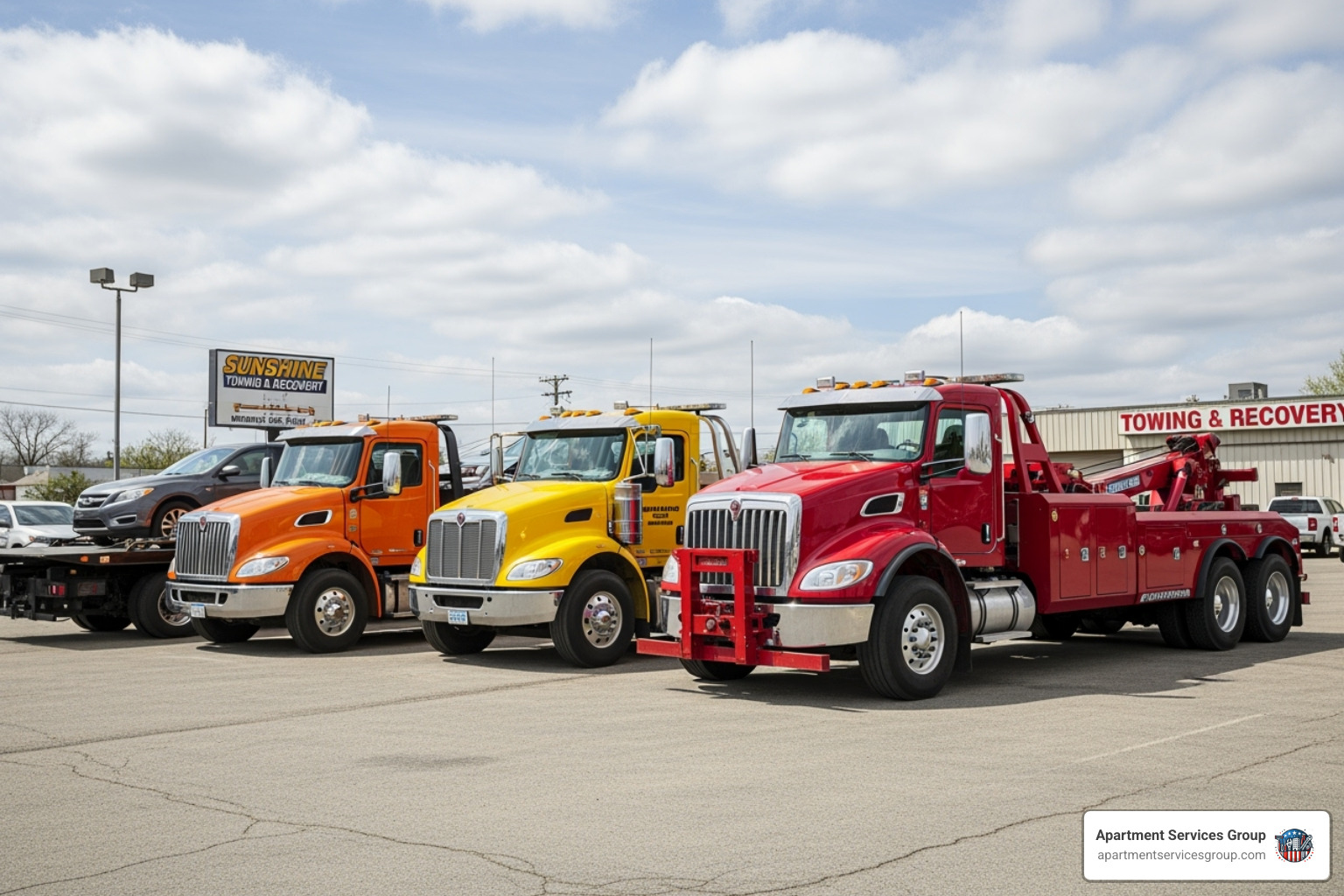
- Light-duty towing is for everyday vehicles like sedans, SUVs, and minivans (under 10,000 lbs / 4,536 kg GVWR). This is the most common and affordable type of tow.
- Medium-duty towing covers larger vehicles like delivery vans, box trucks, and small RVs (10,001 to 26,000 lbs GVWR). These require larger trucks and more expertise, leading to higher costs.
- Heavy-duty towing is for commercial trucks, buses, and large RVs (over 26,000 lbs GVWR). This is a complex operation requiring specialized equipment and highly trained operators, with prices reflecting the complexity.
The type of tow truck also plays a role. Flatbed trucks, which carry the entire vehicle, are ideal for all-wheel-drive cars, luxury vehicles, or damaged cars. Wheel-lift trucks are faster for simple, short-distance tows and can sometimes be cheaper.
For long-distance towing, per-mile or per-kilometer charges add up quickly. A 100-kilometer tow at $5.00/km (after an included 10km) would add $450 in distance fees alone, on top of the base fee. Before agreeing to a long-distance tow, get a complete, itemized quote. Some companies offer flat rates for certain routes, which might be more economical.
Understanding these cost structures is vital for property managers who work with towing partners. It helps ensure the charges are fair and transparent, a principle we follow in all our apartment complex solutions.
Beyond the Tow: Additional Fees to Expect
While the base tow and mileage are the main charges, extra services can significantly increase your final bill. Understanding these additional fees is key to avoiding surprises on your invoice.

What are common additional towing company charges?
If your vehicle isn’t on a flat, paved surface ready to go, expect extra fees. These cover additional time, labor, and equipment.
- Winching and Recovery: If your car is stuck in mud, snow, or a ditch, it needs to be pulled onto solid ground. Basic winching can add $50-$150, but complex recoveries after an accident, potentially requiring heavy-duty rotator booms, can cost hundreds or even thousands per hour.
- After-Hours Service: Tows at night, on weekends, or on holidays typically include a surcharge of $50-$100 to cover premium staff wages.
- Accident Scene Cleanup: If your vehicle leaks fluids like oil or coolant, you’ll be charged for the materials and labor to clean the spill, often billed per quarter-hour.
- Waiting Time: If the tow operator has to wait on-site (e.g., for a police investigation), you may be charged a standby rate per hour.
- Other Fees: Be aware of potential charges for en-route travel to remote locations, fuel surcharges, administrative tasks, credit card processing, and gate fees for after-hours access to an impound lot.
How do storage fees work?
Storage fees are where towing company charges can escalate quickly if you don’t retrieve your vehicle promptly. The clock starts ticking the moment your car arrives at the storage lot.
Fees are typically calculated per 24-hour period. Daily rates vary widely, from $20 to over $60 depending on location and vehicle size. Some regions have much higher regulated rates, with outdoor storage potentially reaching $240 per day and indoor storage costing even more.
Indoor storage is more expensive as it protects your vehicle from weather and potential theft, but outdoor storage is the more economical choice for most situations. Some jurisdictions prorate the first day’s fee, charging hourly for the first few hours, which can save you money if you retrieve your vehicle quickly.
If you need to access the lot outside of normal business hours, you’ll likely face an additional after-hours access fee on top of the daily storage rate. For property managers, explaining this fee structure to residents can emphasize the importance of retrieving a towed vehicle as soon as possible.
For specific regulations, check official sources like this guide to maximum storage rates in Colorado.
Understanding Towing Company Charges and Your Rights
Knowing your rights can save you money and frustration when dealing with a tow. Regulations exist to protect you from unfair towing company charges, whether the tow was from private property or ordered by police.
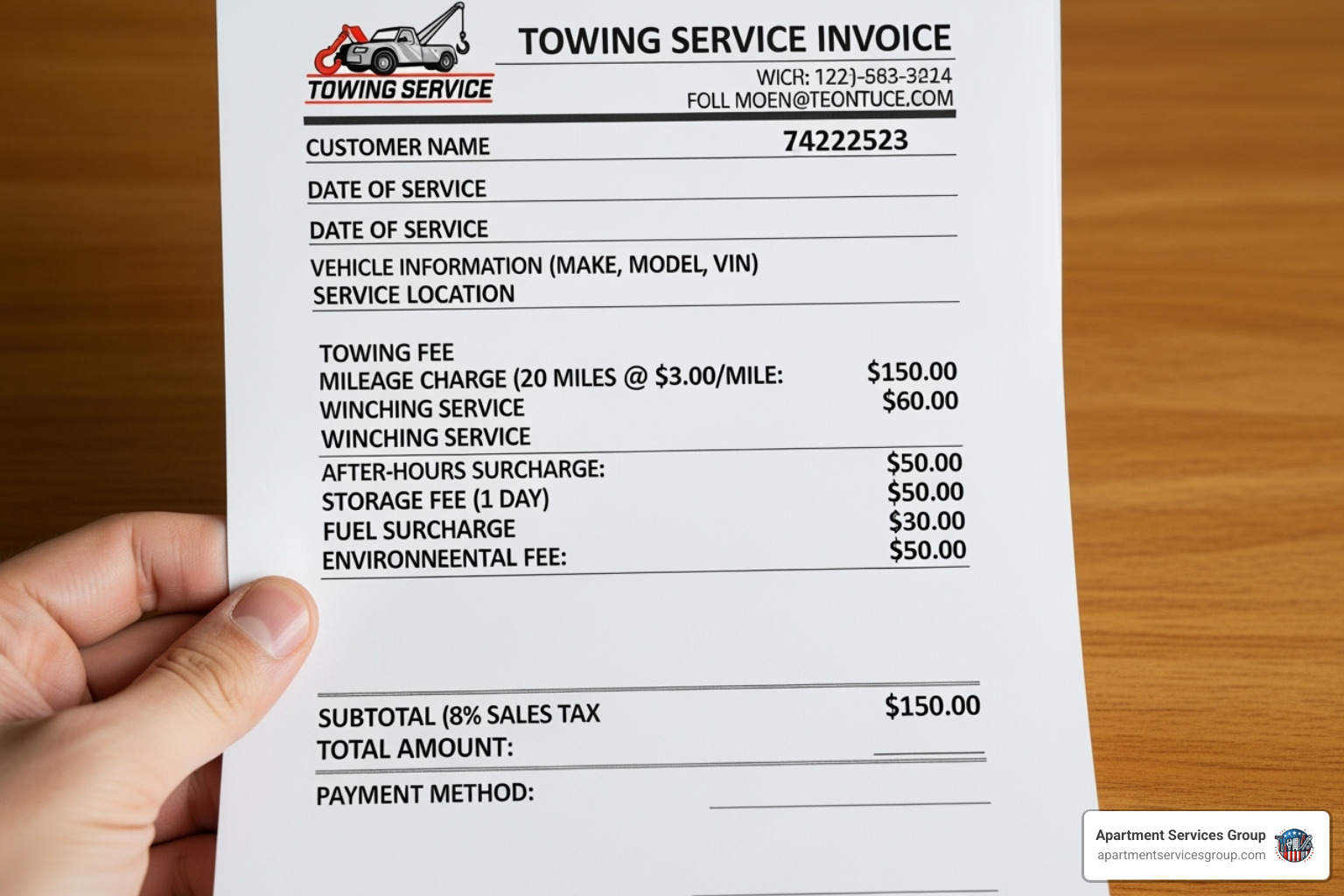
What information must be on a towing invoice?
A legitimate towing company must provide a detailed, itemized invoice. This is your protection against overcharging. It should clearly list every service and its cost, including the base fee, mileage, and any additional work. Vague or bundled charges are a red flag.
The invoice must also include:
- The towing company’s full name, address, phone number, and license number.
- Your vehicle’s information (make, model, VIN, license plate).
- The date, time, and location of the tow, and the reason for it.
- The address of the storage facility.
- Accepted payment methods (many regulations require accepting cash and major credit cards).
In many areas, the invoice must also provide information on how to dispute charges, like the Houston Motorist Bill of Rights. Do not pay until you receive a clear, complete invoice.
What are my rights when towed from private property?
Private property towing, common in apartment complexes, is heavily regulated. Here are your key rights:
- Retrieve Personal Belongings: You have the right to access your vehicle to get essential personal items (like medication, wallets, or phones) without paying the full towing bill. Some lots may charge a small gate fee for after-hours access.
- Maximum Rates: Most jurisdictions cap the rates for private property tows to prevent price gouging. For example, some areas cap light-duty tows at a flat rate like $142 or $170, which may include the first 24 hours of storage.
- Drop Charges: If you return to your car while it’s being hooked up but before it has been moved, you should only have to pay a small, regulated “drop charge” to have it released. In some places, this fee is now prohibited for residential tows.
For property managers, understanding these rules is essential for compliance. At Apartment Services Group, we help properties implement fair and transparent towing policies that protect residents’ rights while maintaining order. Our services, like our Houston parking lot towing services, ensure enforcement is handled correctly. For more on creating effective policies, see our ultimate guide to apartment towing and our parking lot management guide.
How to Avoid Overpaying and Protect Yourself
With a little preparation, you can protect yourself from excessive towing company charges. The best time to learn about towing costs is before you’re stranded on the side of the road.
First, check your auto insurance policy for roadside assistance or towing coverage. You may already be covered for reimbursement. If not, consider joining a roadside assistance program like CAA (Canadian Automobile Association). The annual fee often pays for itself with a single use.
Research reputable towing companies in your area before you need one and save their numbers in your phone. When you call for a tow, always ask for a detailed estimate upfront. A legitimate company can provide a ballpark figure based on your situation.
Be cautious of unsolicited tow offers at an accident scene. These “accident chasers” may charge inflated rates. You have the right to choose your own towing company. Before agreeing to service, verify the company’s branding on the truck and ask for the driver’s ID. Document everything by taking photos and keeping all receipts.
How can insurance or roadside assistance help?
Your insurance or roadside assistance plan can be a financial lifesaver. Insurance policies with towing coverage usually work on a reimbursement basis: you pay the tow company and submit the receipt to your insurer. Know your policy’s limits (e.g., $100 per tow or up to 50 miles).
Roadside assistance memberships often offer direct billing with a network of contracted towers. If your tow is within the plan’s limits, you may pay nothing out of pocket. These memberships are comprehensive, often including battery boosts, flat tire changes, and lockout services. Adding towing coverage to your insurance is also typically inexpensive and well worth the cost.
How do I dispute unfair towing charges?
If you receive a bill that seems excessive, you have options for disputing the towing company charges.
- Contact the Towing Company: Start by calling the company to calmly discuss the specific charges you question. Billing errors or miscommunications can often be resolved directly.
- File a Formal Complaint: If direct contact fails, escalate the issue to the appropriate regulatory body. This could be your local Office of Consumer Protection, a state agency like the Louisiana Public Service Commission, or the Department of Motor Vehicles. These agencies can mediate disputes and enforce regulations.
- Contact the Better Business Bureau (BBB): While not a government agency, the BBB can help mediate and your complaint becomes part of the company’s public record, which can pressure them to find a resolution.
When filing a complaint, be organized. Provide copies of your invoice, estimates, photos, and notes. Clearly state which charges you are disputing and why. For property managers, ensuring your towing partner follows all regulations is key to avoiding legal issues and maintaining a good relationship with residents.
Frequently Asked Questions about Towing Charges
When it comes to towing company charges, a few questions come up repeatedly. Here are straight answers to the most common ones.
What is the average cost of a 5-mile tow?
The cost of a 5-mile tow varies based on location, vehicle type, and time of day. For a standard car during business hours, expect to pay a base fee of $80 to $150. This fee often includes the first few miles. If your tow exceeds the included distance, you’ll pay an additional per-mile rate (typically $2 to $5.65). So, a 5-mile tow will likely cost between $80 and $150, but it’s always best to ask for a specific quote.
Can a towing company keep my car if I can’t pay?
Yes. A towing company can place a lien on your vehicle, giving them the legal right to hold it until you pay the towing and storage fees. Storage fees accumulate daily (from $20 to over $200 per day), so the amount you owe can grow quickly. If the bill remains unpaid for a set period, the company can legally sell your vehicle at auction to recover their costs. If you’re having trouble paying, contact the company immediately to discuss options; ignoring the problem will only make it worse.
Do I have to use the tow truck that arrives at an accident?
No, in most situations, you have the right to choose your own towing company. If a tow truck shows up at an accident that you didn’t call, you are not obligated to use their service. These “accident chasers” sometimes charge inflated rates. If you have roadside assistance, call them to dispatch an approved provider. The only exception is if law enforcement needs to clear the road immediately and calls a truck from their police rotation list for safety. Even then, you should ask about rates and get an itemized invoice.
Conclusion
Unexpected towing company charges can be a major headache, but with the right knowledge, you can steer the situation confidently. We’ve covered the key factors: base fees, mileage, vehicle weight, and additional services that can inflate your bill.
Towing costs vary significantly by region and situation, but the principles of protecting yourself remain the same.
Remember these key takeaways:
- Be Prepared: Check your insurance for towing coverage or join a roadside assistance program. Save the number of a trusted local tow company in your phone.
- Know Your Rights: You are entitled to an itemized invoice, fair pricing, and access to your personal belongings. You can refuse service from unsolicited tow trucks at an accident.
- Demand Transparency: Always ask for a detailed estimate before your vehicle is hooked up. A legitimate company will be upfront about their pricing.
- Dispute Unfair Charges: If you believe you’ve been overcharged, contact the company. If that fails, file a complaint with a consumer protection agency or regulatory body.
For property managers, understanding these rules is vital for maintaining a fair and compliant property. Partnering with a transparent towing provider protects your property and your residents. At Apartment Services Group, we specialize in creating fair, effective towing policies for apartment communities in Houston. Our goal is to maintain order while respecting residents’ rights, reducing conflict and building trust.
Learn more about our comprehensive apartment complex solutions and how we can help create a seamless living experience for your residents.