Cost to paint apartment unit 2025: Expert Savings
Why Understanding Apartment Painting Costs Matters for Property Success
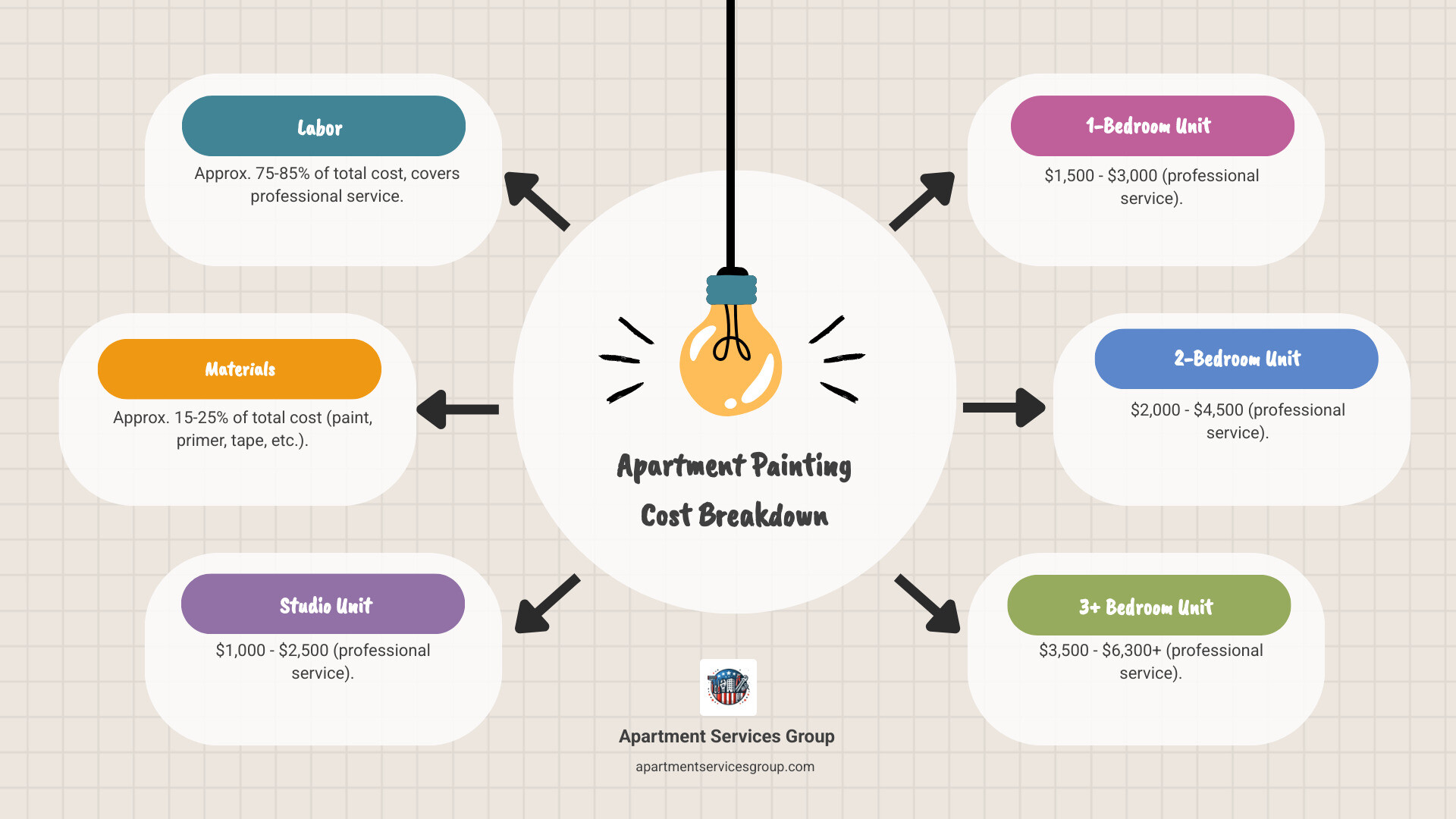
The cost to paint apartment unit can range from $1,000 to $6,300 for professional services, depending on size and scope. Here’s what you need to know:
Quick Cost Overview:
- Studio apartments: $1,000 – $2,500
- 1-bedroom units: $1,500 – $3,000
- 2-bedroom units: $2,000 – $4,500
- 3+ bedroom units: $3,500 – $6,300+
- Cost per square foot: $2.60 – $6.00
- DIY materials only: $500 – $1,000
Whether you’re preparing units for new tenants, refreshing tired spaces, or boosting property values, painting delivers one of the highest returns on investment in property management. Research shows that quality interior painting can provide up to 107% ROI while significantly improving tenant attraction and retention.
Labor typically accounts for 75-85% of total painting costs, making it crucial to understand what drives these expenses. From wall condition and prep work to paint quality and additional surfaces, multiple factors influence your final bill.
As Moe Shariff, owner of Apartment Services Group with over eight years in Houston property services, I’ve helped countless property managers steer the cost to paint apartment unit decisions while maximizing their investment returns. My experience across multiple service companies has shown me exactly what drives painting costs and how to get the best value for your budget.
The Bottom Line: Average Apartment Painting Costs
Let’s cut straight to what you’re here for – the real numbers. The cost to paint apartment unit typically ranges from $2,700 to $6,300 for professional services across the United States as of November 2024. I know that’s a pretty wide range, but there’s good reason for the variation.
The reality is that every apartment is different. A studio with pristine walls needs far less work than a three-bedroom unit where the previous tenant decided to experiment with crayon art. Location matters too – what you’ll pay in Houston differs significantly from costs in San Francisco or small-town Kansas.
The good news? Once you understand how painters price their work, these numbers start making perfect sense.
Cost Per Square Foot
Most professional painters quote jobs between $2.60 and $3.90 per square foot, though I’ve seen prices range from as low as $1 to as high as $6 depending on the complexity and your location.
Here’s how it typically breaks down: A basic job focusing mainly on walls with minimal prep work usually falls around $3 to $4 per square foot. This includes your paint, essential materials, and labor – basically everything you need for a clean, fresh look.
But if you need a detailed job with extensive patching, multiple coats, or specialized finishes, expect prices to climb toward $6 to $8 per square foot. Think of it as the difference between a quick refresh and a complete change.
Regional differences play a huge role too. For example, painters in Calgary charge between $2 and $3 per square foot including trim, walls, and ceilings. In Fort McMurray, the rate jumps to around $3.50 per square foot. These variations highlight why getting local quotes is so important.
Cost by Apartment Size
Square footage drives everything when it comes to painting costs. More space means more paint, more time, and naturally, more money. Here’s what you can realistically expect:
| Apartment Size (Sq. Ft.) | Number of Bedrooms | Estimated Professional Painting Cost Range |
|---|---|---|
| <500 sq. ft. | Studio | $1,000 – $2,500 |
| 500 – 750 sq. ft. | 1-Bedroom | $1,500 – $3,000 |
| 750 – 900 sq. ft. | 2-Bedroom | $2,000 – $4,500 |
| 900+ sq. ft. | 3+ Bedrooms | $3,500 – $6,300+ |
Let me give you some real-world examples that illustrate these ranges. A typical one-bedroom condo around 600 square feet usually costs between $1,500 and $1,700 to paint professionally. For a two or three-bedroom condo, you’re generally looking at $2,000 to $3,500.
I’ve seen quotes for a standard 900-square-foot apartment including ceiling and trim average around $4,500. On the larger side, a 1,700 square foot apartment with three bedrooms, living areas, one bathroom, and kitchen can range from $1,680 for labor-only work up to $5,000 for a complete quality job with premium materials.
The wide price variations you’ll encounter make sense when you consider the scope differences. A quick apartment turnover might focus on speed and basic coverage, while a luxury renovation prioritizes premium materials and detailed finishing work.
Understanding these baseline costs gives you a solid foundation for budgeting your painting project. But remember, several key factors can push your final bill higher or lower than these averages – and that’s exactly what we’ll explore next.
What’s in the Price? Key Factors That Drive Up the Cost to Paint an Apartment Unit
When you’re trying to understand the cost to paint apartment unit, it’s helpful to think of painting like an iceberg. What you see on the surface – the fresh, beautiful walls – represents just a fraction of what goes into the project. The real work happens beneath, in the preparation, skill, and attention to detail that creates a lasting finish.
At Apartment Services Group, we’ve learned through years of Houston property services that about 85% of your total painting costs go toward labor, with materials and supplies making up the remaining 15%. This might surprise property managers who assume paint is the biggest expense, but it highlights just how much expertise and time contribute to a quality result.
Think about it this way: a skilled painter doesn’t just roll paint onto walls. They’re protecting your floors, carefully cutting edges, ensuring even coverage, and creating clean lines that make the difference between a professional job and a DIY disaster. For insights on how we transform entire living spaces, check out our Expert unit remodeling for modern living.

Wall Condition and Prep Work
The condition of your apartment’s walls is probably the biggest factor in determining your final painting bill.
New paint versus repaint jobs can vary dramatically in cost. Brand-new apartments or those with recently repaired walls often need more extensive prep work, including putty application, primer, and multiple coats of paint. Repainting existing walls might only require touch-ups and one or two fresh coats if the current surface is in good shape. However, if you’re going from a dark color to something lighter, expect to pay for additional coats.
Drywall repair is where costs can really add up. Small holes from picture hangers or doorknobs typically run $20 to $135 to fix, while larger holes can cost $50 to $200. Most contractors charge around $40 to $45 per hour for general wall repairs, and the time adds up quickly when there’s extensive damage.
Skim coating becomes necessary when walls have significant texture, imperfections, or old wallpaper residue. This process creates a smooth canvas for painting but adds about $0.98 per square foot, or $300 to $1,200 per room. For extensive work, costs can reach $12 per square foot.
Wallpaper removal is one of those jobs that looks simple but can turn into a nightmare. The adhesive, the steaming, the scraping – it’s messy, time-consuming work that significantly increases prep costs.
For older apartments built before 1978, lead paint can be a serious concern. Testing costs between $350 and $500, and if lead is present, removal adds $8 to $15 per square foot to your total bill. Safety is absolutely paramount here, and we always recommend professional handling. You can find more details at Information on lead paint safety.
Paint Quality and Finish
The paint you choose affects both your upfront costs and how long your investment will last. It’s tempting to go with the cheapest option, but this is one area where spending a bit more often pays off.
Latex paint is the workhorse of the industry. It’s affordable, easy to clean, and won’t fade over time. However, it might require multiple coats for full coverage, especially when making dramatic color changes. Oil-based paint costs more and is harder to clean up, but it offers superior durability and smoother coverage. It’s typically reserved for trim or high-traffic areas where the extra durability matters.
The finish you choose makes a real difference in both appearance and practicality. Matte or flat finishes hide imperfections beautifully and are easy to touch up, but they scuff easily and aren’t great for high-traffic areas. Eggshell and satin finishes offer a nice middle ground – they’re more durable and washable than matte, with just enough sheen to look neat. Semi-gloss and gloss finishes are the workhorses for kitchens, bathrooms, and trim because they’re highly durable and easy to clean, though they’ll highlight any wall imperfections.
Standard interior paints range from $30 to $80 per gallon, while premium options from companies like Benjamin Moore can cost $100 or more per gallon. Before you balk at the higher price, consider that quality paints often provide better coverage (meaning fewer coats) and superior durability that saves money over time.
Additional Surfaces
Most quotes for the cost to paint apartment unit focus on walls, but other surfaces can significantly impact your total investment.
Ceiling painting often gets overlooked, but fresh ceilings can transform a space. Expect to add $1 to $2 per square foot for ceiling work. A 600-square-foot apartment might cost $800 to $1,000 for flat ceilings, while popcorn ceilings could run $900 to $1,300 due to the extra difficulty involved.
Trim and baseboards require precision and patience, adding $2 to $5 per square foot to your project. For a typical apartment, this translates to $350 to $700. Crown molding runs about $0.65 per linear foot.
Doors and windows need careful taping and detailed work. Each standard door costs $75 to $125 to paint professionally, while French doors might run around $300. Closet interiors typically add $50 to $150 per closet, and accent walls, while visually striking, may incur slight additional costs due to the need for different colors and more precise edging work.
Understanding these factors helps you make informed decisions about where to invest your painting budget for maximum impact.
DIY vs. Hiring a Professional: A Cost-Benefit Analysis
When facing the cost to paint apartment unit, many property owners and managers find themselves at a crossroads: Should we roll up our sleeves and do it ourselves, or bring in the professionals? It’s tempting to think DIY automatically saves money, but the reality is more nuanced than that. Our Houston Renovating Services team has seen how this decision impacts both budgets and outcomes.
The appeal of DIY is understandable. You’re looking at immediate savings on labor costs, which we know make up about 85% of professional painting expenses. But here’s the thing – those savings often come with hidden costs that can surprise even the most prepared property managers.
The True Cost to Paint an Apartment Unit Yourself
When you choose the DIY route, your main expense becomes materials and tools, typically running $500 to $1,000 for a standard apartment. This covers everything from paint and primer to brushes and drop cloths.
You’ll need quite a bit of equipment to do the job right. Essential supplies include paint and primer (obviously), but also paint rollers, brushes for detail work, painter’s tape, and drop cloths to protect surfaces. Don’t forget paint trays, sanding materials, spackle for wall repairs, and a good ladder. You’ll also want cleaning supplies and putty knives for prep work.
But here’s where it gets interesting – and potentially expensive. The “true cost” goes far beyond what you’ll spend at the hardware store. Time becomes your biggest investment, and in property management, time really is money.
A professional crew can transform an apartment in 2-3 days. Your weekend DIY project? That’s looking more like 2-3 weeks of evenings and weekends. For property managers, this extended timeline can mean lost rental income or delayed tenant placement. I’ve watched well-intentioned property owners start a “simple” painting project in January and still be touching up walls in March.
Then there’s the learning curve. Prep work is everything in painting, and it’s where most DIY projects go wrong. Inadequate surface preparation leads to peeling paint, uneven coverage, and the dreaded “do-over” – which can actually cost more than hiring professionals from the start.
The Value of a Professional Painter
For property managers juggling multiple units and tight schedules, professional painters offer something invaluable: predictability and peace of mind.
Speed and efficiency top the list of professional advantages. A skilled team can prep and paint a two-bedroom apartment in just one to two days. That means minimal downtime for your unit and faster tenant turnover. When you’re losing $100+ per day on an empty apartment, professional speed quickly pays for itself.
Quality is where professionals really shine. They know how to handle tricky situations – like painting over dark colors, dealing with textured walls, or working around built-in fixtures. Their finish will be even, streak-free, and durable. This isn’t just about aesthetics; it’s about longevity. A professional paint job typically lasts years longer than amateur work.
Insurance and liability protection might not be exciting, but it’s crucial. Professional painters carry insurance that protects you from accidents or damage during the project. Try explaining to your insurance company why your tenant fell through a ceiling because your weekend painting crew wasn’t properly equipped.
No cleanup hassle means exactly that. Professionals handle everything from setup to final cleanup, leaving your apartment move-in ready.
The return on investment speaks for itself. Quality interior painting can deliver up to 107% ROI, but only when done right. A professional job ensures you maximize this return by creating a fresh, attractive space that commands better rental rates and attracts quality tenants faster.
While the upfront cost to paint apartment unit professionally might seem higher, the combination of time savings, guaranteed quality, and increased property value makes it a smart investment for most property managers. Sometimes the most expensive option is the one that looks cheapest at first glance.
Maximizing Value & Getting Accurate Quotes
Smart property owners know that painting isn’t just about making things look pretty—it’s one of the most powerful tools you have to boost your investment returns. When you’re weighing the cost to paint apartment unit, you’re not just spending money; you’re making a strategic investment that pays dividends through higher rental rates, faster tenant turnover, and increased property value.

The numbers speak for themselves. A quality paint job can add up to 5% to your property’s sale price, and research shows that interior home painting can result in a 107% ROI. That means for every dollar you spend on professional painting, you’re likely to see more than a dollar back in increased value or rental income.
Think about it from a tenant’s perspective. When they walk into a freshly painted apartment with crisp, clean walls, they immediately feel like they’re getting something special. That feeling translates into willingness to pay market rates and sign leases faster.
Choosing Colors That Increase ROI
Here’s where many property owners get it wrong—they either play it too safe with boring beige or go too bold with personal color preferences. The sweet spot lies in understanding what today’s renters and buyers actually want.
Neutral color schemes remain the gold standard for good reason. They create a blank canvas that lets potential tenants imagine their own belongings in the space. But “neutral” doesn’t have to mean bland. Modern greys, warm taupes, and crisp whites can feel fresh and sophisticated rather than sterile.
Our go-to recommendations include cool-toned greys like Benjamin Moore’s Sidewalk Gray for contemporary appeal, or warm classics like Benjamin Moore’s Smokey Taupe for a cozy feel. When you want that ultimate clean, fresh look, nothing beats an all-white like Benjamin Moore’s Chantilly Lace.
High-impact colors deserve consideration too, especially when you’re trying to stand out in a competitive rental market. Zillow’s analysis on home paint colors reveals specific shades that consistently drive higher offers. We stay current with these trends and incorporate them into our color consultations, ensuring your units align with stunning 2025 apartment interior trends.
The key is striking the right balance between timeless appeal and current style. You want colors that feel fresh today but won’t look dated in three years.
How to Get a Clear and Fair Estimate
Getting accurate quotes for the cost to paint apartment unit shouldn’t feel like solving a mystery. The more transparent you are about your needs, the more accurate and fair your estimates will be.
Start by providing detailed project information. Include exact square footage, number of rooms, ceiling heights, and honest assessments of wall conditions. Are there nail holes throughout? Water stains on the ceiling? Old wallpaper that needs removal? These details directly impact prep time and material costs.
Always ask what’s included in the quote. A good contractor will break down exactly what you’re paying for—paint quality, primer, materials, labor, prep work, and cleanup. If something seems unclear, ask. Reputable painters want you to understand exactly what you’re getting.
Compare multiple quotes, but don’t just focus on the bottom line. Three to four estimates give you a good range to work with. Be suspicious of quotes that seem too good to be true—they usually are. Low-ball estimates often hide corners that will be cut later, whether in prep work, paint quality, or cleanup.
Check reviews and references thoroughly. Online reviews tell you how contractors handle real-world challenges and customer service. Ask for recent references and actually call them. Find out if projects were completed on time, within budget, and to expectations.
The cheapest quote rarely delivers the best value. Focus on finding contractors who provide fair pricing, clear communication, and proven track records. Your investment in quality painting will pay off for years to come.
Frequently Asked Questions about Apartment Painting
We get a lot of questions from property managers and owners about apartment painting. From timelines to tenant rights, let’s dive into the most common concerns that come up when planning your cost to paint apartment unit budget.
How long does it take to paint an apartment?
The timeline for painting an apartment depends heavily on who’s doing the work and what condition the walls are in.
Professional crews work with impressive speed and efficiency. A typical two-bedroom apartment in average condition can be completely painted in just one to two days. For larger units or those needing extensive prep work, you’re looking at two to three days maximum. This speed comes from having the right tools, years of experience, and often working in coordinated teams.
DIY projects are a completely different story. What takes professionals a couple of days could easily stretch into multiple weekends – sometimes two to three weeks of part-time work. This is especially true if you’re new to painting or tackling a larger unit.
Several factors can extend the timeline regardless of who’s doing the work. Covering dark colors with light paint requires more coats, complex layouts with lots of trim work take longer, and extensive prep work like patching holes or removing wallpaper adds significant time.
Do costs vary by location?
Absolutely! The cost to paint apartment unit can swing dramatically depending on where your property is located. It’s all about local labor costs, market demand, and general cost of living.
High-cost cities like New York City and San Francisco command premium prices. In NYC, you might pay $5.71 to $10.62 per square foot, with 2-bedroom units running $3,000 to $7,000. San Francisco sees rates around $2.75 to $4.89 per square foot. These cities have higher labor rates and business overhead costs that get passed along to customers.
Midwest and lower cost-of-living areas offer more budget-friendly options. While rates vary, they typically fall within the national average range we discussed earlier.
Houston-specific pricing offers a sweet spot – competitive rates that balance quality with affordability. As a Houston-based company, we’ve seen that our local market provides excellent value compared to the highest-cost cities while maintaining professional standards. Large apartment complex projects here can range significantly based on scope, but individual units remain reasonably priced within the national average.
As a tenant, am I allowed to paint my apartment?
This question comes up constantly, and the answer isn’t always straightforward. Your lease agreement is your best friend here.
Start with your lease agreement – it should spell out exactly what you can and can’t do. Many leases clearly state whether painting is allowed, if you need written permission, or if there are restrictions on colors and finishes.
Getting landlord permission is always smart, even if your lease doesn’t explicitly forbid painting. Property managers often prefer neutral colors that appeal to future tenants. A quick conversation can save you headaches later.
Be prepared to restore the original color when you move out, especially if you’ve gone bold with your choices. Dark or bright colors almost always need to be painted over with neutral tones before the next tenant moves in. This work could come out of your security deposit if you don’t handle it yourself.
Some cities have specific regulations too. New York City, for example, requires landlords to paint apartments every three years, which can influence what tenants expect and what landlords allow.
The key is communication. Property managers want happy tenants, and tenants want to personalize their space. A little planning and conversation upfront prevents disputes and unexpected costs down the road.
Conclusion
Understanding the cost to paint apartment unit doesn’t have to feel overwhelming when you break it down into manageable pieces. Throughout this guide, we’ve explored how costs typically range from $1,000 for a studio to over $6,300 for larger units, with that crucial 85/15 split between labor and materials driving most of your expenses.
The key takeaway? Painting consistently delivers exceptional value for property owners and managers. Whether you’re refreshing tired walls to attract new tenants or boosting your property’s market appeal, a quality paint job offers one of the highest returns on investment in real estate – up to 107% ROI according to industry research.
While DIY might seem tempting for your budget, the reality is that professional services bring speed, quality, and peace of mind that’s hard to match. When you consider lost rental income from extended vacancy periods, potential mistakes that need fixing, and the time investment required, professional painting often proves more cost-effective in the long run.
From wall condition and prep work to paint quality and those finishing touches on trim and ceilings, every factor we’ve discussed plays a role in your final investment. But remember – this isn’t just an expense, it’s a strategic move that makes your units more desirable and commands better rental rates.
At Apartment Services Group, we’ve spent over eight years helping Houston property managers steer these decisions with confidence. Our unparalleled expertise and dedication means you get that seamless, transformative result that keeps tenants happy and your properties competitive.
Ready to see what fresh paint can do for your property’s success? Schedule a Consultation with our experts today and find how we can help maximize your investment returns with a flawless finish that pays dividends for years to come.